
Family, school or industry: who shapes young people’s career choices?
Latvia’s forest sector is currently in a paradoxical position. On the one hand, it is one of the country’s most stable economic pillars and a significant export success story. On the other – the sector is facing a serious labour shortage, while young people show critically low interest in careers in manufacturing, forestry and STEM fields more broadly.
Recent data from three studies –
- Edurio & Fonds AUGT “Latvia’s Youth Career Survey 2025”;
- RTU & LDDK “Knowledge Transfer Barometer 2025”;
- World Economic Forum “Future of Jobs Report 2025”
reveal systemic gaps between education and labour‑market reality. The young generation aspires to education, but enters the labour market with low confidence and only a fragmentary understanding of the sectors where jobs and good pay will actually be.
Searching for tomorrow – “I don’t know what I’m supposed to know”
The career survey, which involved 4 881 students from 152 Latvian schools, shows that only 40% feel very or rather confident about their career decisions. In vocational schools this figure reaches 49%, while in general secondary schools it is just 35%, suggesting that practically oriented education gives young people a clearer “sense of ground” than time spent in an academic upper‑secondary track.
After completing upper‑secondary education, 66% of students plan to obtain a higher‑education degree, but gender differences are striking: 76% of girls and 52% of boys plan to go to university. Meanwhile, 10% of boys plan to apply for the State Defence Service, compared to only 1% of girls.
One student formulates this uncertainty very precisely: “I don’t know what my next 10 minutes in life will be like – how can I know where and when I will be in the future?”
So, for more than half of respondents, their inner sense of place in tomorrow’s labour market is still shrouded in fog. What do young people actually hear when they are planning their next steps?
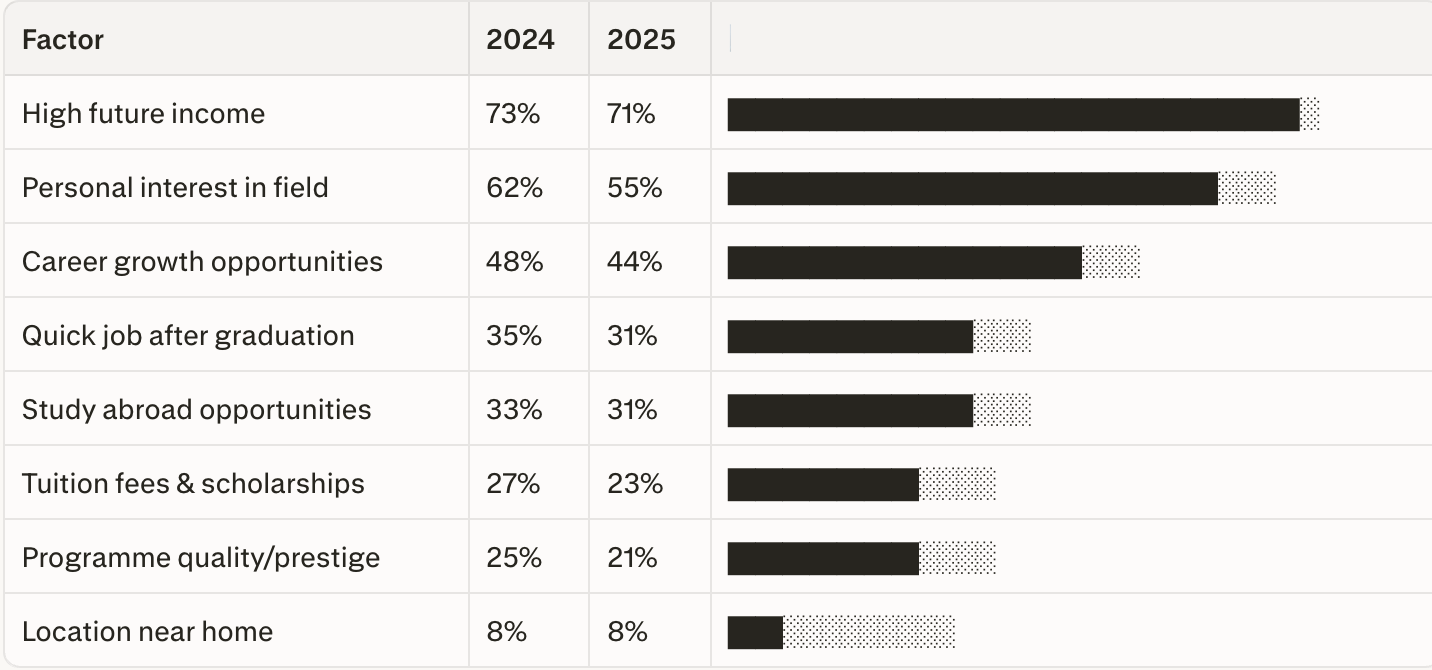
The core factors shaping study and career choices are stable: the top priority is the prospect of high earnings (71%), followed by personal interest in the field and opportunities for career growth.
What is missing is a clear understanding of which sectors actually meet these criteria.
Edurio & Fonds AUGT “Latvia’s Youth Career Survey 2025”
Dream sectors vs. reality
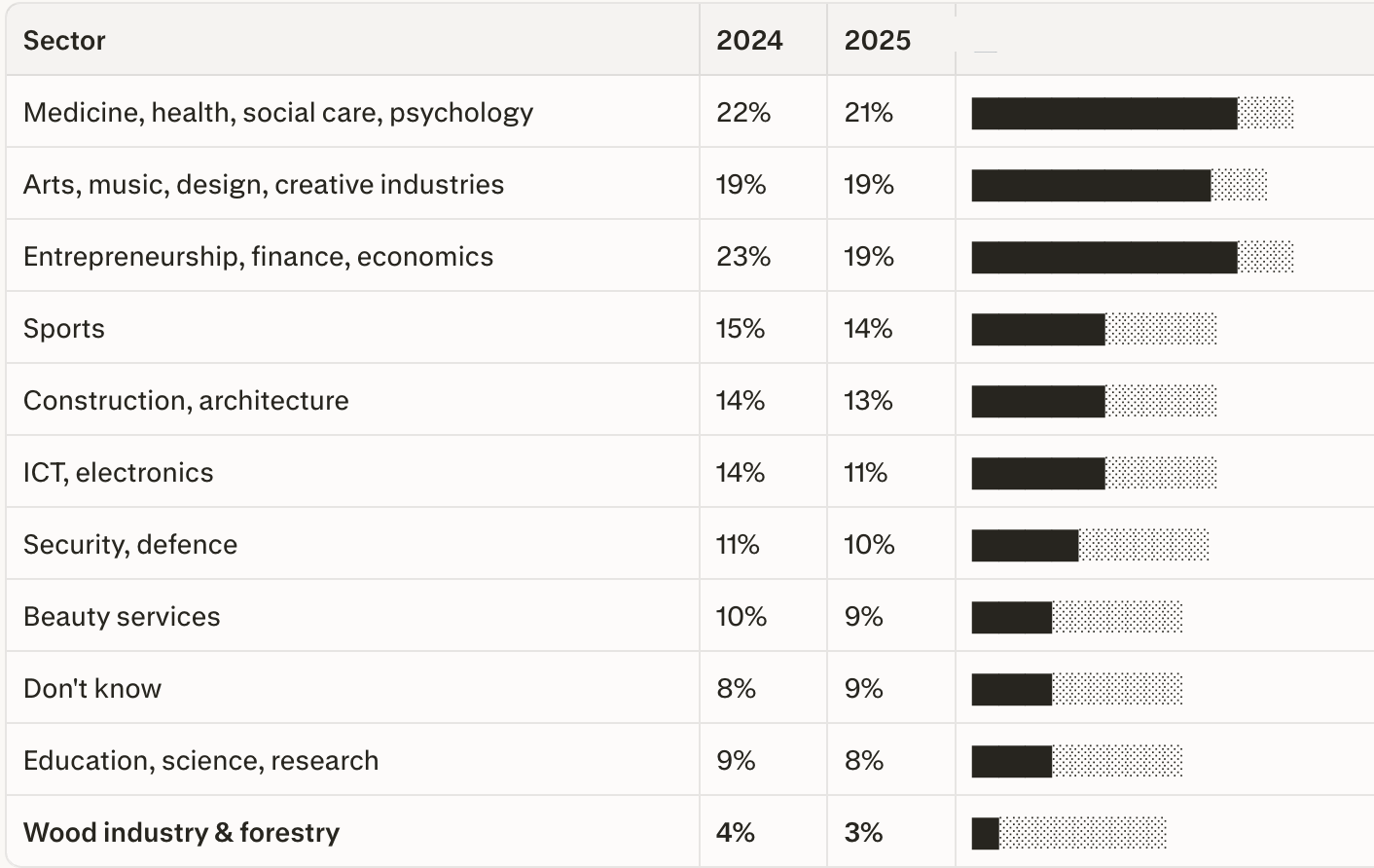
The data show a clear contrast between young people’s dreams and the structure of the labour market. The three most attractive fields where students see themselves at the age of 30 are:
medicine, health, social work and psychology;
arts, music, design and creative industries;
entrepreneurship, finance and economics.
Girls most often choose medicine, creative industries and beauty services, while boys gravitate towards business and finance, ICT and sports.
In contrast, manufacturing, transport and logistics, energy, agriculture and forestry, as well as STEM fields overall, attract very little interest from students. Forestry and wood processing appear at the bottom of the preference list, even though average wages in many companies in the sector exceed the national average and approach or match EU levels. Young people simply do not know this.
In the end we get a peculiar “equation of facts and opinions”: a sector that contributes significantly to GDP, provides stable jobs and good pay, is weighed against loud anti‑campaigns. While these emotional narratives erode the sector’s prestige, young people naturally turn towards careers that are perceived as respected and easily understood by society – such as medicine, law or creative industries.
This is not only a Latvian story. OECD “Education at a Glance 2025” shows that in many countries students’ study choices lag behind labour‑market needs, creating substantial skills mismatches.
Edurio & Fonds AUGT “Latvia’s Youth Career Survey 2025”
who really influences career choices?
It is a misconception that young people’s career decisions are primarily controlled by TikTok algorithms and influencers. The data tell a different story: parents and family still have the strongest influence on career choice (57%). The role of “inspirational sources” (books, films, media) has dropped significantly – by 11 percentage points – down to a modest 13%.
Given the decisive role of family in young people’s choices, it is crucial that society’s views and knowledge about sectors and the labour market keep pace with reality and future trends. If parents’ perceptions of forestry or STEM are rooted in the 1990s, this “filter” inevitably shapes the decisions of the next generation.
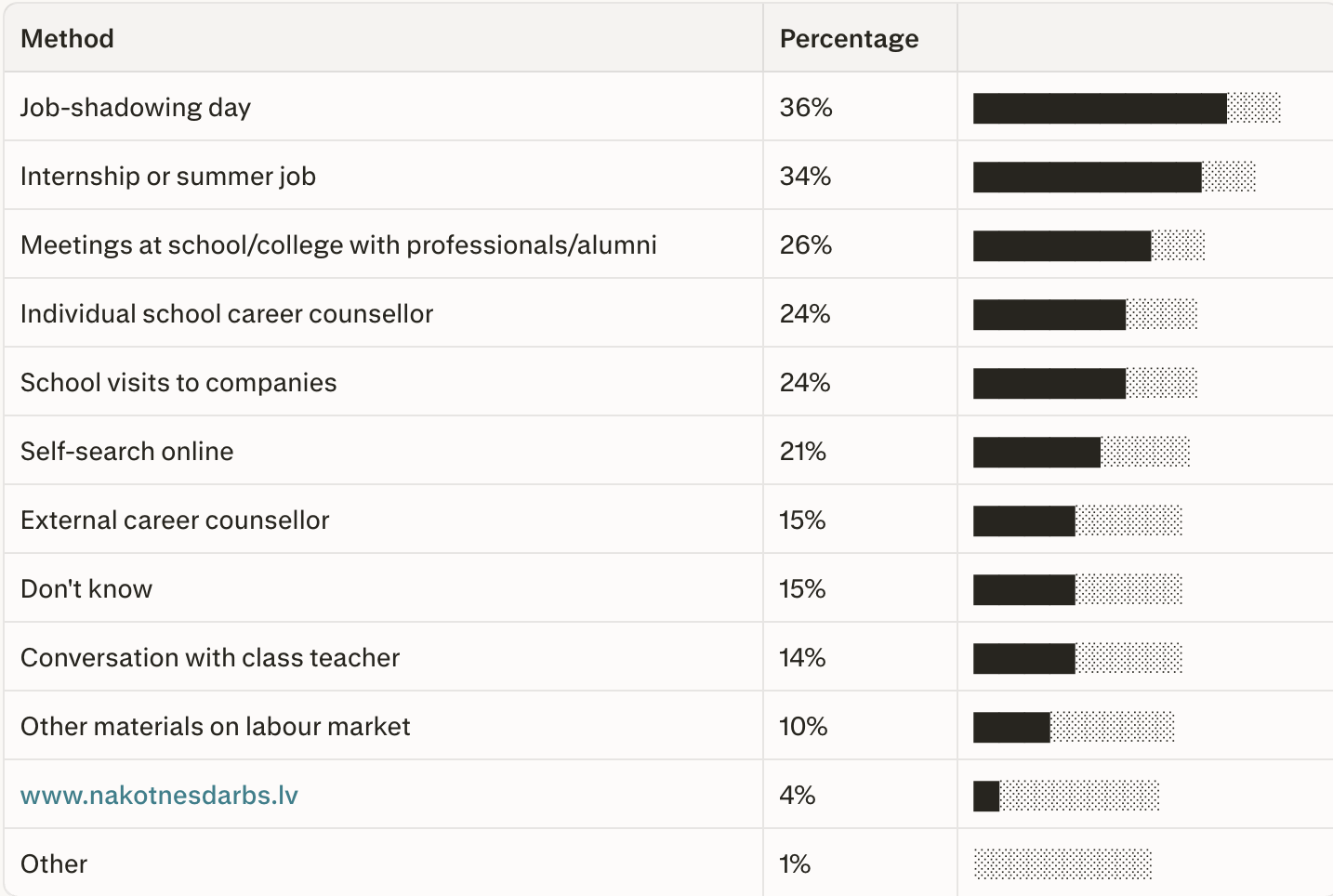
When asked how they themselves look for information about careers, students most often mention the internet – 37% of respondents choose this option. At the same time, they clearly say they want to explore professions in practice:
36% would prefer job‑shadowing days;
34% – internships or summer jobs;
26% – meetings with professionals.
This shows a gap between the forms of career education students actually experience and the formats they would find most useful.
Career support at school is also underused. Only 17% of students have had an individual meeting with a school career counsellor, and only 7% consider the counselling to have been very useful. Meanwhile, 14% say they have not taken part in any career‑education activity at all. In practice, most career exploration still happens individually, online – sometimes successfully, but often with a strong element of chance.
International OECD data show that closer links between education and the workplace – for example, work‑based learning – are associated with better employment and earnings outcomes, especially in STEM and vocational education. Yet in many countries, including Latvia, the intensity of such opportunities remains limited.
Edurio & Fonds AUGT “Latvia’s Youth Career Survey 2025”
Education and business
The RTU & LDDK “Knowledge Transfer Barometer” shows that Latvian companies generally rate their cooperation with universities as rather positive – the average score is 3.9 out of 5 – but the potential of this cooperation is far from fully realised. Collaboration is most active in the study domain, primarily through student internships and work‑based learning, while involvement in research, innovation and technology transfer is much lower.
The main barriers companies identify are: lack of information about cooperation opportunities, limited internal resources and complex, bureaucratic procedures within universities. At the same time, employers say they are most motivated to work with universities in order to attract qualified graduates and students, and to upgrade their current employees’ skills. In other words, the interest is there – but a clear, simple path to practical collaboration is often missing.
In the forest sector we can already see what is possible when companies actively engage in education. Participation in initiatives such as “Lietkoku čemodāns” (“Solid Wood Suitcase - STEM Kit for schools”) and long‑term internships with schools and VET colleges shows a simple but important truth: companies are under no legal obligation to patch gaps in the education system, but every such step becomes a concrete example of sustainability and social responsibility.
How to change the “dream sector” ranking?
The latest studies point quite clearly to where efforts should be focused: long‑term internships, the principle “every company has its own intern”, transparent communication about average wages and career progression in the sector, and targeted work with parents and teachers – the people who in practice act as young people’s career advisers and trusted confidants.
The new generation is not lazy or unambitious - data show they want stability, meaning and a predictable development path. The question is whether forestry and wood processing are presented as first‑choice options rather than last‑resort alternatives. And how to reach the roughly 60% of students who are still undecided about their future career direction.
To ensure that young people are not unpleasantly surprised when they face their first major decisions, our shared responsibility – as parents, teachers, employers and policy‑makers – is to make sure they have access to honest, data‑based information about the labour market and different sectors. The rest they are fully capable of deciding for themselves.
Iveta Narkēviča